

Your Leading Niobium Particles Supplier
Shaanxi Zhongheng Weichuang Metal Materials Co., Ltd. specializes in the export of metal materials. From smelting to export, we strive for excellence. The company mainly engages in the production of conventional processed profiles such as plates, strips, foils, rods, wires, and tubes made of tantalum, niobium, hafnium, tantalum tungsten alloy, niobium hafnium alloy c103. Niobium particles has a high melting point, strong electron emission ability, and gas absorption ability, which can be used to make electronic tubes and other vacuum devices.


Why Choose Us?
Professional Team
The company has many years of experience in technology and a high-quality work team, which can provide customers with timely and comprehensive service.
Quality Assurance
We maintain strict control over every stage, from raw material smelting to finished product export, to ensure the selection of high-quality metal materials and to meet the highest standards at every step.
Production Market
Our non-ferrous metals, such as tantalum, niobium, and titanium, are primarily exported to North America, Europe, and Asia.
Wide Range of Applications
Our products are widely used in a variety of fields, including electronics, metallurgy, chemicals, aerospace, biomedical engineering, and superconductivity, etc.
Types of Niobium Particles
Niobium Particles
Niobium particles are a granular material made of niobium metal. Due to their special properties such as high melting point, corrosion resistance, chemical stability, and superconductivity, they are widely used in multiple fields.
High melting point niobium particles
High melting point niobium particles are metal particles with extremely high melting points, mainly made of niobium (Nb). Its melting point is usually above 2468 degrees Celsius, making it excellent in high-temperature applications.

Parameters of Niobium Particles
|
Property |
Value |
|
Purity |
99.99% (4N) – 99.9999% (6N) |
|
Available Forms |
Pellets, Targets, Ingots, Powders |
|
Evaporation Temperature |
300°C – 2500°C (varies by material) |
|
Density |
1.6 – 21.4 g/cm³ (varies by material) |
|
Application Fields |
Optics, Electronics, Semiconductor, Solar Cells |
|
Coating Method |
Thermal Evaporation, Electron Beam Evaporation |
Features of Niobium Particles
High Purity & Uniformity:
Ensures high-quality deposited films, enhancing device performance.
Excellent Evaporation Properties:
Maintains a stable evaporation rate, improving coating consistency.
Wide Material Selection:
Suitable for diverse coating requirements in optics, electronics, and semiconductors.
Precise Dimension Control:
Available in various forms like pellets, targets, and ingots, fitting different equipment needs.
Dimensions: Customizable
MOQ: Customized
Physical Characteristics of Niobium Particles
|
Density (near room temperature) |
8.57 g/cm3 |
|
Liquid density at melting point |
7.83(fusion、liquid) g/cm3 |
|
Melting point |
2741 K, 2468 °C |
|
Boiling point |
5015 K, 4742 °C |
|
Heat of fusion |
30 kJ/mol |
|
Heat of vaporization |
689.9 kJ/mol |
|
Heat capacity |
(25 °C) 24.60 J/(mol·K) |
Applications of Niobium Particles
Superconductors:
Niobium is a superconductor. It boasts the largest magnetic penetration depth of all the known elements. Alloyed with titanium, the Niobium-Titanium alloy is superconducting at temperatures below ten Kelvin and can be found in superconducting magnets in hospital MRI equipment & several large superconducting magnets (the Tevatron accelerator at Fermilab & the large Hadron Collider).
Medical Diagnostic Equipment:
Niobium is found in the superconducting magnets used in Magnetic Resonance Imaging (MRI) scanners and Nuclear Magnetic Resonance (NMR) medical diagnostic equipment.
Oil & Gas Pipelines:
In amounts as low as 0.1 per cent, Niobium increases the strength of the resulting alloys, particularly at low temperatures. It also improves the alloy's corrosion resistance, making it an ideal candidate for use in oil rigs and oil & gas pipelines.
Jewelry & Coinage:
Niobium is light weight, very malleable and similar to platinum in appearance. It is inert, hypoallergenic & scratch resistant. Anodizing Niobium creates a thin oxide layer that creates a range of permanent colors by diffraction of light. By varying voltages during the anodizing process, different layers of oxides are formed, resulting in a unique rainbow of iridescent colors. The jewelry industry offers rings, bracelets, necklaces and chainmaille jewelry designs created from Niobium.
Aerospace & Military Industry:
Alloyed with other metals, the resulting high temperature-stable superalloys are used in jet engine afterburner liners, as burst disks for wind tunnels, reaction control nozzles for missiles and control nozzles for satellites. The niobium alloy also resists high frequency vibrations at cryogenic temperatures, which occurs in many satellite applications.
Optical Glass Production:
Niobium oxide is one of the raw materials used in lanthanum borate glasses. Lanthanum borate glasses are optical glasses having a high refractive index and a relatively low value of optical dispersion. The Niobium oxide compounds increase the refractive index of the glass and allow for corrective glasses to be made with thinner lenses.
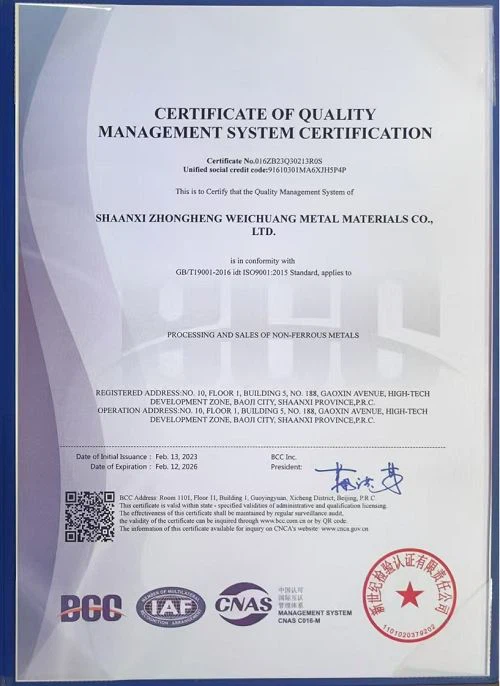
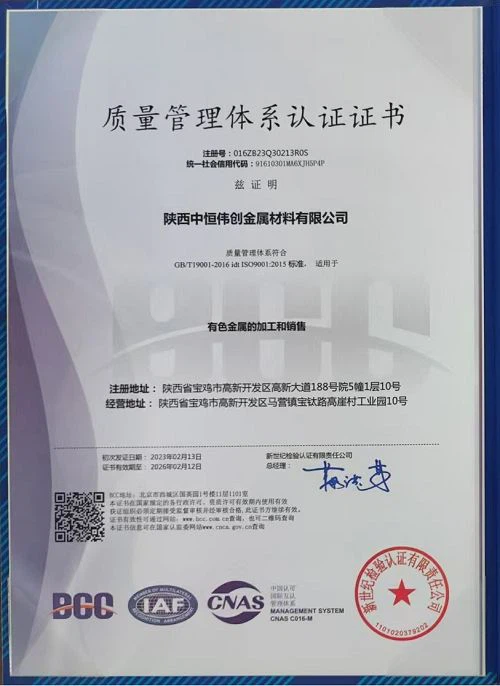
Certificate


Shipping & Payment
|
Shipping: |
By logistics; by automobile; by train; by shipping; by air. |
|
Payment: |
L/C; T/T; Paypal; West Union; MoneyGram etc. |
Packaging of Niobium Particles


FAQ
We're professional niobium particles manufacturers and suppliers in China, specialized in providing high quality customized service. We warmly welcome you to buy niobium particles for sale here and get pricelist from our factory. For price consultation, contact us.