

Your Professional Tantalum Niobium Raw Material Manufacturer!
Shaanxi Zhongheng Weichuang Metal Materials Co., Ltd. is located in the High-tech Development Zone of Baoji City, Shaanxi Province. Its main products include conventional processed profiles and deep-processed products such as tantalum, niobium, titanium, zirconium, nickel, vanadium and their alloys. The company's products are widely used in many fields such as electronics industry, metallurgy industry, chemical industry, aerospace, biomedical engineering and superconducting industry.
Why Choose Us
Professional Team
Our company boasts an experienced and highly skilled professional team. Leveraging years of accumulated technical expertise and a pool of high-caliber talent, we are committed to providing customers with timely, efficient, and comprehensive after-sales service.
Quality Control
We specialize in the export of metal materials. We maintain strict control over every stage, from raw material smelting to finished product export, to ensure the selection of high-quality metal materials and to meet the highest standards at every step.
Qualification Certification
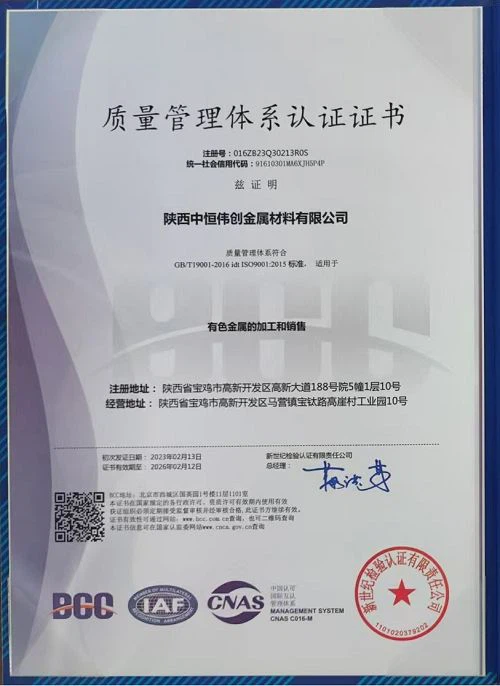
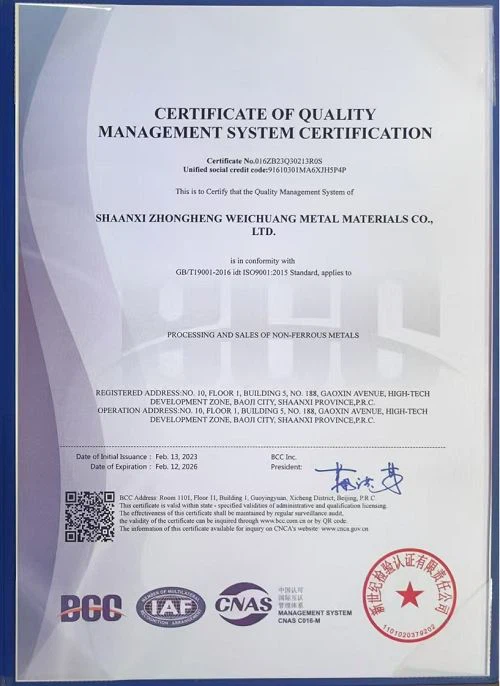
We have obtained ISO9001 quality management system certification, ensuring that our product quality and service levels adhere to international standards.
Sales Market
Our products are primarily exported to North America, Europe, and Asia, and we have established a robust international market network.


Our Best-Selling Tantalum Niobium Raw Material Products
Our Company Has More Products to Offer, Please Browse the Product Categories on the Website, If You Have Any Needs, Please Contact Us.
Melting Niobium
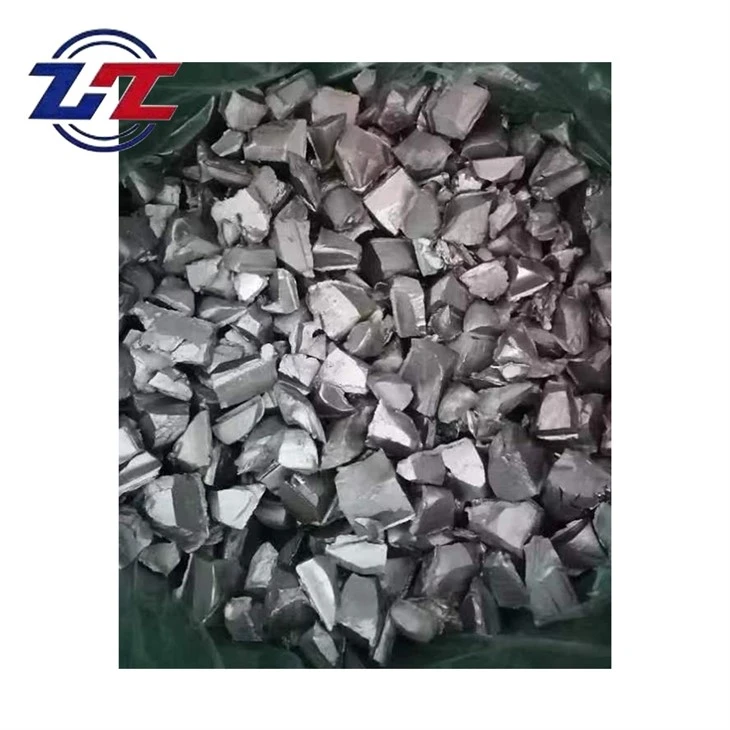
Melting niobium usually refers to the liquid or semi-solid form of niobium metal or niobium alloy obtained through the melting process, or the intermediate product formed after the initial cooling of this liquid metal. At this stage, smelting niobium may require further processing or treatment, such as casting, forging, or rolling, to form the final niobium product. Niobium ingot is a block shaped product formed by melting niobium, cooling and solidifying it.
Tantalum Block For Melting
Tantalum block for smelting is a block of tantalum material specifically used in the smelting process. Tantalum is a metal with a high melting point, high hardness, and high corrosion resistance, with a melting point of around 3000 ° C, making it very suitable for high-temperature melting environments.
In the preparation method of tantalum blocks, from the extraction of tantalum ore to the final formation of tantalum blocks, it covers multiple stages such as smelting, refining, and processing.
Niobium Particles
Niobium particles are a solid particle form of metallic niobium, whose properties are mainly derived from the physical and chemical properties of metallic niobium. Niobium is an important microalloying element in steel. Adding a small amount of niobium can significantly improve the properties of steel, such as increasing its strength, toughness, high temperature oxidation resistance, and corrosion resistance, reducing its brittle transition temperature, and making it have good welding and forming properties.
Niobium Strip
Niobium strip is a gray white, tough, and malleable refractory metal with high melting point (2468 ℃) and boiling point (4742 ℃). It has good thermal and electrical conductivity, as well as high resistance to deformation and corrosion. Niobium has stable chemical properties and forms a dense oxide film on its surface at room temperature, preventing further oxidation.
Facts About Tantalum Raw Materials
|
Atomic number |
73 |
|
CAS number |
7440-25-7 |
|
Atomic mass |
180.95 [g/mol] |
|
Melting point |
2996 °C |
|
Boiling point |
5458 °C |
|
Density at 20 °C |
16.65 [g/cm3] |
|
Crystal structure |
Body-centered cubic |
|
Coefficient of linear thermal expansion at 20 °C |
6.4 × 10⁻⁶ [m/(mK)] |
|
Thermal conductivity at 20 °C |
57.5 [W/(mK)] |
|
Specific heat at 20 °C |
0.14 [J/(gK)] |
|
Electrical conductivity at 20 °C |
8.0 × 10⁶ [S/m] |
|
Specific electrical resistance at 20 °C |
0.125 [(Ωmm2)/m] |
Manufacturing Process of Tantalum
Tantalum is a dark blue-gray metal that is hard, dense, and ductile. It is also easily fabricated, highly conductive to electricity and heat, and exceptionally resistant to corrosion.
Separation:
Since tantalum is often found with niobium, it must undergo a separation process before it can be further refined and used. This process involves treating the ore with a mixture of hydrofluoric acid and sulfuric acid at elevated temperatures, which dissolves the tantalum and niobium into complex fluorides.
Conversion:
The purified tantalum solution can be turned into tantalum oxide (Ta2O5) or potassium tantalum fluoride (K2TaF7) as needed.

Purification:
Since other elements are generally present within the ore, the slurry is first filtered and then further processed using a solvent extraction process that uses methyl isobutyl ketone or a liquid ion exchange process that uses an amine extractant in kerosene. The result is a highly purified solution of tantalum.
Metal Production:
The final step is to convert the tantalum compound into pure tantalum metal using an electrolytic or chemical reduction process.
● Arc-welding rods for stabilized grades of stainless steel
● Nuclear reactor control rod due to its high temperature and corrosion resistance, and low neutron absorption at cross-section
● Crucibles for synthetic diamond manufacturing
● Sodium vapor lamb, and LCD back lighting
● Jewelry: Brilliant colors can be created on niobium surface
● Superconductor, supercollider and particle accelerator using ultra-high purity metals and alloys
● Optical coating and camera lens
● Lithium niobite for wave guide in communications
● Thin film solar cell
Niobium Characteristics
Chemical Properties
|
Chemical Data |
|
|
CAS number |
7440-03-1 |
|
Thermal neutron cross section |
1.1 barns/atom |
|
Ionic radius |
0.7 Å |
|
Electro negativity |
1.6 |
|
Electrochemical equivalent |
0.0693 g/A/h |
Physical Properties
|
Properties |
Metric |
Imperial |
|
Density |
8.4 g/cm3 |
0.303 lb/in3 |
|
Melting point |
2410 °C |
4370 °F |
|
Boiling point |
5100 °C |
9212°F |
Mechanical Properties
|
Properties |
Metric |
Imperial |
|
Tensile strength (at room temperature) |
275 MPa |
40 ksi |
|
Modulus of elasticity |
105 GPa |
15250 ksi |
|
Shear modulus |
38 GPa |
5511 ksi |
|
Poissons Ratio |
0.4 |
0.4 |
|
Hardness, Brinell |
736 |
736 |
|
Hardness, Vickers |
1320 |
1320 |
|
Hardness, Mohs |
6 |
6 |
Thermal Properties
|
Properties |
Metric |
Imperial |
|
Thermal expansion co-efficient (@20-100°C/68-212°F) |
7.3 µm/m°C |
4 µin/in°F |
|
Thermal conductivity |
53.7 W/mK |
1133 BTU in/hr.ft².°F |
Manufacturing Process of Niobium
Niobium—initially known as columbium—is a lustrous gray metal with a high melting point and low density. It is highly ductile and superconductive.
There are two main processes used for niobium production. They are utilized depending on whether pyrochlore or columbite and tantalum-bearing ores are being processed.
Pyrochlore Ores:
These ores undergo a process that converts the niobium oxide into HSLA ferroniobium. The conversion is performed either through an aluminothermic reduction process or by reduction in an electric arc furnace.
Columbite and Tantalum-bearing Ores:
These ores undergo the same chemical process outlined in the Tantalum section. Typically, ammonia is introduced to the purified solution of niobium to convert it into niobium hydroxide. The resulting compound is then washed, filtered, and calcined.
Metal Production:
The calcined niobium hydroxide is then reduced to pure niobium metal using an electrolytic or chemical reduction process.
● Medical devices
● Nuclear energy
● Aerospace
● Surgical implants
● Electronics
● Optical lenses
● Chemical industry
● Particle accelerators (CERN)

Packing
We will be carefully placed in wooden cases or cartons with additional support from soft materials to prevent any shifting during transportation. This packaging method guarantees the integrity of the products throughout the delivery process.

Our Certificate


FAQ
We're professional tantalum niobium raw material manufacturers and suppliers in China, specialized in providing high quality customized service. We warmly welcome you to buy tantalum niobium raw material for sale here and get pricelist from our factory. For price consultation, contact us.
tantalum powder for industrial applications, tantalum materials for high end electronics, tantalum alloy for mechanical parts