

Your Leading Hafnium Wire Supplier
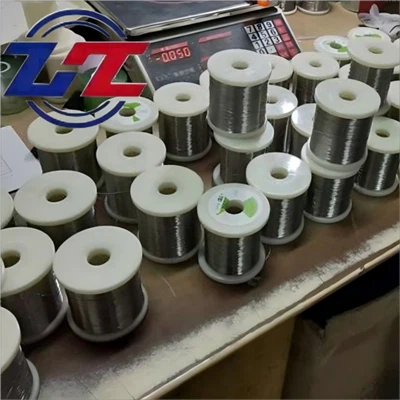
Shaanxi Zhongheng Weichuang Metal Materials Co., Ltd. specializes in the export of metal materials. From smelting to export, we strive for excellence. Hafnium wire is a material drawn from hafnium metal, with a silver white luster, a melting point of 2227 ° C, and a density of 13.1 grams per cubic centimeter. Hafnium wire has good mechanical properties at high temperatures, and its corrosion resistance is better than titanium, approaching that of tantalum and niobium. It's used in high-temperature components, nuclear reactor control rods, and as an alloying element in various materials.



Why Choose Us?
Professional Team
The company has many years of experience in technology and a high-quality work team, which can provide customers with timely and comprehensive service.
Quality Assurance
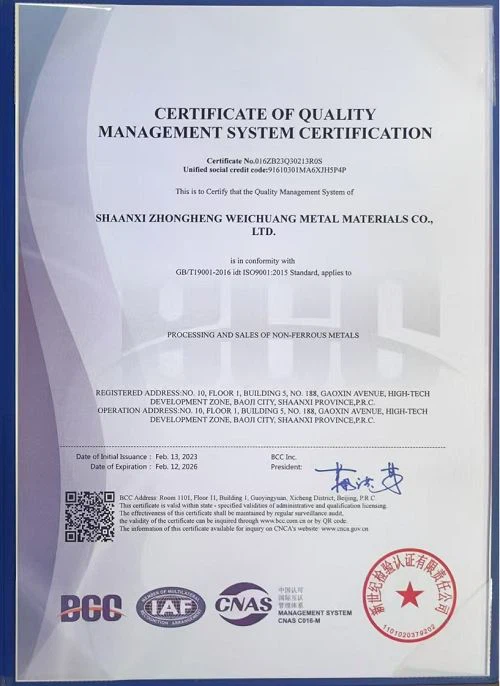
We maintain strict control over every stage, from raw material smelting to finished product export, to ensure the selection of high-quality metal materials and to meet the highest standards at every step.
Production Market
Our non-ferrous metals, such as tantalum, niobium, and titanium, are primarily exported to North America, Europe, and Asia.
Wide Range of Applications
Our products are widely used in a variety of fields, including electronics, metallurgy, chemicals, aerospace, biomedical engineering, and superconductivity, etc.
Parameters of Hafnium Wire
|
Purity |
Hf+Zr > 99.95%, Zr < 1% |
|
Standard |
ASTM B737 |
|
Size |
Dia: 0.1mm-5.0mm ( tolerance: +/-0.05mm ) |
|
Condition |
Cold drawn, Annealed |
|
Shape |
Coils or Customers’ Requests |
|
Surface |
Silver metal |
|
Packing |
Standard seaworthy packages or as your requests |
Properties of Hafnium Wire
High Melting Point:
Hafnium has a melting point of approximately 2233°C (4051°F), which makes it suitable for high-temperature applications.
Corrosion Resistance:
Hafnium exhibits excellent resistance to corrosion, particularly in aggressive environments, which ensures durability and longevity.

Neutron Absorption:
One of the most critical properties of hafnium in nuclear applications is its high neutron absorption cross-section. This means it can effectively absorb neutrons, making it invaluable in controlling nuclear reactions.
Mechanical Strength:
Hafnium maintains its mechanical strength at high temperatures, crucial for structural components in nuclear reactors.
Physical Properties of Hafnium Wire
|
Appearance |
Silver |
|
Melting Point |
2227 °C |
|
Boiling Point |
4602 °C |
|
Density |
13.31 g/cm3 |
|
Solubility in H2O |
N/A |
|
Electrical Resistivity |
35.1 microhm-cm @ 25 °C |
|
Electronegativity |
1.3 Paulings |
|
Heat of Fusion |
6.0 Cal/gm mole |
|
Heat of Vaporization |
155 K-Cal/gm atom at 4602 °C |
|
Poisson's Ratio |
0.37 |
|
Specific Heat |
0.035 Cal/g/K @ 25 °C |
|
Tensile Strength |
N/A |
|
Thermal Conductivity |
0.230 W/cm/K @ 298.2 K |
|
Thermal Expansion |
(25 °C) 5.9 µm·m-1·K-1 |
|
Vickers Hardness |
1760 MPa |
|
Young's Modulus |
78 GPa |
|
Melting Point |
2506 K (2233°C, 4051°F) |
|
Boiling Point |
4876 K (4603°C, 8317°F) |
|
Heat of Fusion |
27.2 kJ/mol |
|
Heat of Vaporization |
648 kJ/mol |
|
Molar Heat Capacity |
25.73 J/(mol•K) |
Applications of Hafnium Wire
Aerospace industry: Is used to manufacture high-temperature components such as aircraft engine blades and rocket engine nozzles.
Nuclear industry: Hafnium Wire (Hf Wire) is used as a cladding material for nuclear fuel rods due to its excellent neutron-absorbing properties.
Petrochemical industry: Hafnium Wire (Hf Wire) is used to produce corrosion-resistant reactors for chemical processing.
BHafnium Wire (Hf Wire) can be used as an alloying element in combination with other materials such as tungsten and chromium to enhance their properties.
Hf Wire and other Hf parts are also used in plasma cutting because of their ability to shed electrons into the air. Cut hafnium wire could be inserted into copper parts to make a cutting tip for the plasma cutter.
Engineering Controls: Ensure adequate ventilation to maintain exposures below occupational limits. Whenever possible the use of local exhaust ventilation or other engineering controls is the preferred method of controlling exposure to airborne dust and fume to meet established occupational exposure limits. Use good housekeeping and sanitation practices. Do not allow dusts to accumulate as they may present a serious fire hazard. Do not use tobacco or food in work area. Wash thoroughly before eating or smoking. Do not blow dust off clothing or skin with compressed air.
Respiratory Protection: If permissible levels are exceeded, use NIOSH approved dust respirator.
Eye Protection: Safety glasses
Skin Protection: Wear impermeable gloves, protective work clothing as necessary.
Certificate


Packaging of Hafnium Wire
Standard Packing: In Coils or on Spools, and loaded in the Wooden Box or the Carton Box.
Our Hafnium Wire (Hf Wire) are carefully handled to minimize damage during storage and transportation and to preserve the quality of our products in their original condition.

fAQ
We're professional hafnium wire manufacturers and suppliers in China, specialized in providing high quality customized service. We warmly welcome you to buy hafnium wire for sale here and get pricelist from our factory. For price consultation, contact us.
Hafnium Wire