

Your Leading Titanium Tube Supplier
Shaanxi Zhongheng Weichuang Metal Materials Co., Ltd. specializes in the export of metal materials. From smelting to export, we strive for excellence. Titanium tube is a type of pipe made of titanium or titanium alloy, characterized by high strength, low density, corrosion resistance, and good biocompatibility. With the advancement of technology and the increasing demand for applications, titanium tubes have broad prospects for application in aerospace, medical, and new energy fields.


Why Choose Us?
Professional Team
The company has many years of experience in technology and a high-quality work team, which can provide customers with timely and comprehensive service.
Quality Assurance
We maintain strict control over every stage, from raw material smelting to finished product export, to ensure the selection of high-quality metal materials and to meet the highest standards at every step.
Production Market
Our non-ferrous metals, such as tantalum, niobium, and titanium, are primarily exported to North America, Europe, and Asia.
Wide Range of Applications
Our products are widely used in a variety of fields, including electronics, metallurgy, chemicals, aerospace, biomedical engineering, and superconductivity, etc.
Parameters of Titanium Tube
|
Density |
4.51g/cm3 |
|
Purity |
99.95% |
|
Shape |
Tube |
|
Color |
Slivery |
|
Grade |
Gr1 Gr2 Gr5 |
|
Size |
Customized |
|
Application |
Medical/Aerospace |
|
Characteristic |
Heat-resistant |
|
Surface |
Bright surface |
|
Melting point |
1942K |
|
Package |
Paper/Wooden box |
|
MOQ |
1kg |
Characteristics of Titanium Tube
Lower Density
The density of titanium tubes is significantly lower than steel, copper, or nickel products. Despite their low density, they are very strong and rigid when compared to other alloy components.
Resistant to Chemicals
Corrosion is not the only thing that titanium tubes are resistant to. They are also resistant to chemicals. These titanium parts can withstand different chemical compounds while still preforming effectively.

Resistant to Corrosion
Another benefit of utilizing titanium tubing is that titanium alloys are resistant to corrosion. This makes these tubes an appealing option if you need a part to work efficiently in a highly corrosive environment.
Great Heat Transfer
Corrosion is not the only thing that titanium tubes are resistant to. They are also resistant to chemicals. These titanium parts can withstand different chemical compounds while still preforming effectively.
Customization Options
Grade: Customizable
1
>>
Thickness: Customizable
2
>>
Size: Customizable
3
>>
Shape: Customizable
4
>>
Surface Treatment: Customizable
5
>>
MOQ: Customizable
6
Chemical Properties of Titanium Tube
|
CAS number |
7440-32-6 |
|
Thermal neutron cross section |
5.6 barns/atom |
|
Electrode potential |
0.20 V |
|
Lonic radius |
0.680 Å |
|
Electro negativity |
1.54 |
|
X-ray absorption edge |
2.497 Å |
|
Electrochemical equivalent |
0.4468 g/A/h |
Application Industries of Titanium Tube
Aerospace Industry
Titanium tubes play a critical role in the aerospace sector due to their high strength-to-weight ratio, excellent corrosion resistance, and ability to withstand extreme temperatures. They are commonly used in hydraulic systems, fuel lines, and structural components of aircraft and spacecraft. The lightweight nature of titanium helps reduce the overall weight of the aircraft, enhancing fuel efficiency and performance. Additionally, titanium's ability to withstand high-pressure environments makes it ideal for engine components and exhaust systems.
Chemical Processing
The chemical industry relies on titanium tubes for their exceptional corrosion resistance. These tubes are widely used in heat exchangers, piping systems, and reactors where exposure to aggressive chemicals such as acids, chlorine, and seawater can rapidly degrade other metals. Unlike stainless steel, titanium does not suffer from crevice corrosion, stress corrosion cracking, or pitting, making it an ideal material for applications in oil and gas refineries, desalination plants, and pharmaceutical production.
Medical Field
Titanium's biocompatibility and non-toxic properties make it the preferred material in the medical industry. Titanium tubes are extensively used in implants, prosthetics, and surgical instruments. Unlike other metals, titanium does not trigger allergic reactions or cause adverse effects in the human body, allowing for long-term use in bone implants, dental implants, and pacemakers. Its lightweight yet strong structure also makes it ideal for use in medical tools, enhancing the precision and durability of surgical equipment.
Sports Equipment
Titanium's combination of lightweight properties and high strength has made it a game-changer in sports equipment manufacturing. Titanium tubes are commonly used in bicycle frames, golf clubs, tennis rackets, and high-performance wheelchairs. The material provides enhanced durability without adding extra weight, making it a preferred choice for professional athletes and sports enthusiasts. Additionally, titanium's resistance to fatigue and impact ensures that equipment remains reliable under intense physical conditions.
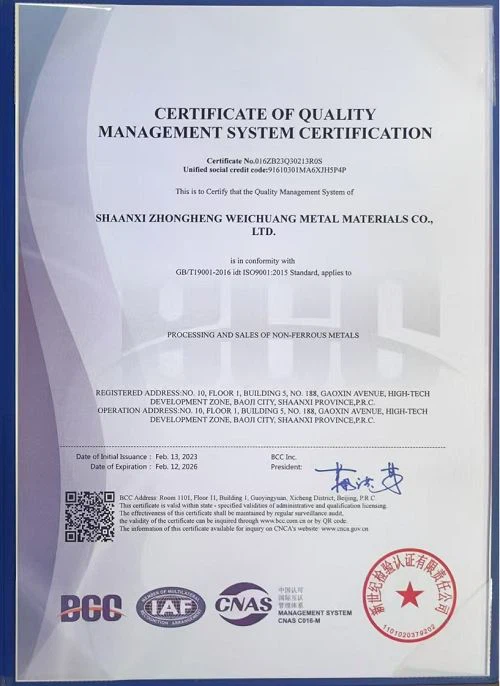
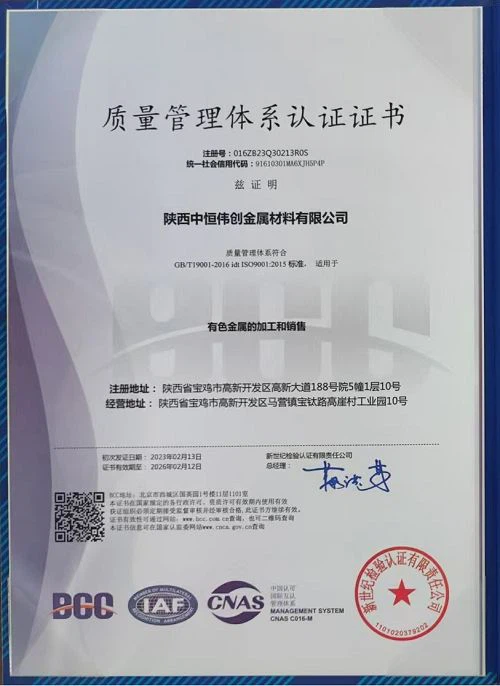
Certificate


Packaging of Titanium Tube
The Titanium Tube is carefully placed in wooden cases or cartons with additional support from soft materials to prevent any shifting during transportation.
This packaging method guarantees the integrity of the products throughout the delivery process.

fAQ
We're professional titanium tube manufacturers and suppliers in China, specialized in providing high quality customized service. We warmly welcome you to buy titanium tube for sale here and get pricelist from our factory. For price consultation, contact us.