

Your Leading Hafnium Raw Material Supplier
Shaanxi Zhongheng Weichuang Metal Materials Co., Ltd. specializes in the export of metal materials. The company mainly engages in the production of conventional processed profiles such as plates, strips, foils, rods, wires, and tubes made of tantalum, niobium, hafnium, tantalum tungsten alloy, niobium hafnium alloy c103, as well as deep processed products such as boats, crucibles, sputtering targets, coating targets, machined parts, high-temperature furnace insulation screens, heating elements, furnace bodies (heating furnaces, annealing furnaces), and corrosion-resistant equipment. Our hafnium raw material is available in hafnium powder and hafnium ingot. Hafnium has the properties of high-temperature resistance, corrosion resistance, oxidation resistance, easy processing, rapid heat absorption, and heat release.


Why Choose Us?
Professional Team
The company has many years of experience in technology and a high-quality work team, which can provide customers with timely and comprehensive service.
Quality Assurance
We maintain strict control over every stage, from raw material smelting to finished product export, to ensure the selection of high-quality metal materials and to meet the highest standards at every step.
Production Market
Our non-ferrous metals, such as tantalum, niobium, and titanium, are primarily exported to North America, Europe, and Asia.
Wide Range of Applications
Our products are widely used in a variety of fields, including electronics, metallurgy, chemicals, aerospace, biomedical engineering, and superconductivity, etc.
Types of Hafnium Raw Material
Hafnium Powder
Hafnium powder is a silver gray metal powder made from hafnium, with a metallic luster, a density of 13.3g/cm ³, a melting point of up to 2227 ° C, and a boiling point of 4602 ° C. It has a high absorption cross-section and is widely used as a material for nuclear reactor control rods in the atomic energy industry.
Hafnium Ingot
Ingot is the raw material form of hafnium, usually in the shape of a cylinder with a diameter between 3-25mm. Its purity can reach 99.99%, and it can contain different proportions of zirconium (such as 0.2%, 0.3%, or 0.5%). Ingots are mainly used as raw materials for the production of hafnium products, such as cathodes for X-ray tubes, electrodes for high-voltage discharge tubes, and absorbers for gas filling systems.

Parameters of Hafnium Raw Material
|
Material |
Hafnium(Hf) |
Purity |
More than 99.9% |
|
Melting point |
2230℃ |
Boiling point |
4602℃ |
|
Density |
13.31g/cm3 |
Atomic weight |
178.49 |
|
Water solubility |
Insoluble |
Atomic number |
72 |
The Preparation Methods of Hafnium Raw Material
Magnesium reduction method:
Produced by reducing hafnium tetrachloride with metallic magnesium.
Thermal decomposition method:
Obtained by thermal decomposition of hafnium tetraiodide.
Electrolysis method:
Preparation of hafnium compounds by electrolyzing hafnium compounds in a molten salt medium.
Mechanical Properties of Hafnium Raw Material
|
Properties |
Metric |
Imperial |
|
Tensile strength |
485 MPa |
70300 psi |
|
Yield strength |
125 MPa |
18100 psi |
|
Poisson's ratio |
0.265 |
0.265 |
|
Shear modulus |
54 - 58 Gpa |
7.83204- 8.41219 psi |
|
Elongation at break |
25% |
25% |
Usage of Hafnium Raw Material
1. Uses of Hafnium in the Field of Electronic Materials
Since hafnium emits electrons easily, it can be used as a cathode for X-ray tubes. In addition, alloys of hafnium and tungsten or molybdenum are also used as electrodes for high-voltage discharge tubes.
2. Uses of Hafnium in the Field of Chemistry
Hafnium can be used as a getter for many inflation systems. The hafnium getter can remove unnecessary gases such as oxygen and nitrogen present in the system. Hafnium has strong anti-volatility and is often used as an additive for hydraulic oil to prevent the volatilization of hydraulic oil during high-risk operations.
3. Uses of Hafnium in the Atomic Energy Industry
Hafnium metal has excellent welding performance, processing performance, high-temperature resistance, and corrosion resistance, so it has become an important material in the atomic energy industry. Hafnium has a large thermal neutron capture cross-section and is an ideal neutron absorber. It can be used as a control rod and protection device for atomic reactors.
4. Uses of Hafnium in the Field of Alloy Materials
Hafnium has the characteristics of ductility, oxidation resistance, and high-temperature resistance. Therefore, hafnium is also a good alloy material and is used in many alloys. Hafnium can also be used in tungsten wire manufacturing. Adding element hafnium to tungsten, molybdenum, and tantalum alloys can produce carbide alloys and heat-resistant alloys.
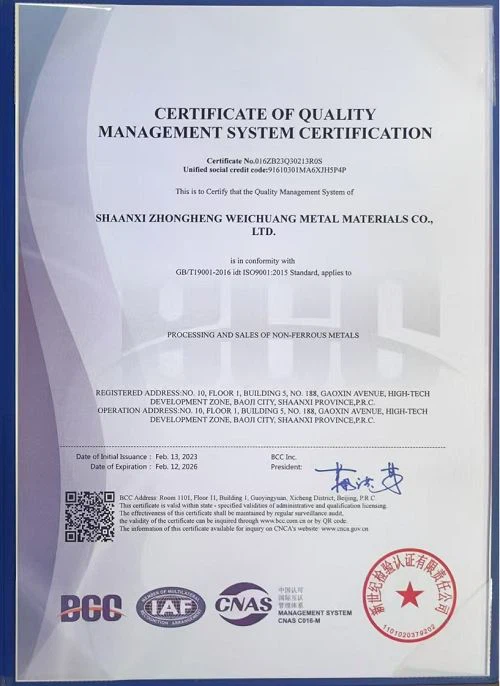
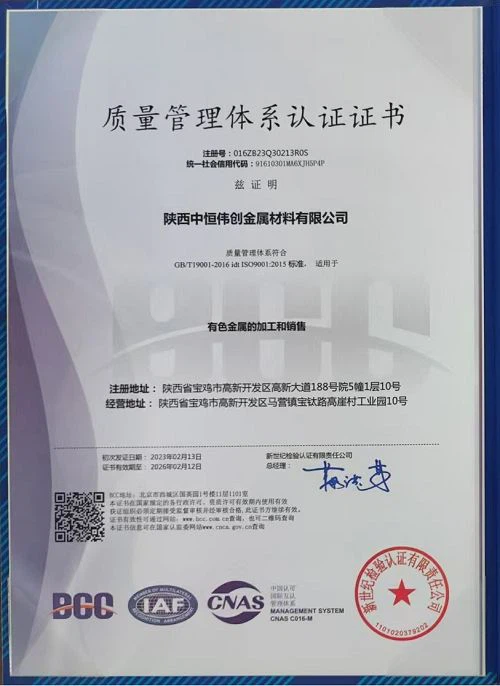
Certificate


Safe Handling and Storage of Hafnium Raw Material
Precautions for Safe Handling:
Avoid dust formation. Keep finely divided hafnium away from any source of ignition and cleaned up immediately. This material is generally not considered hazardous in its solid form. However, if your process creates fines or dusts precautions must be taken.
Keep away from any source of ignition. Provide adequate ventilation if dusts are created. Avoid breathing dust or fumes. Avoid contact with skin and eyes. Wash thoroughly before eating or smoking.
Conditions for Safe Storage:
Store in a cool, dry area. Store away from acids.

Packaging of Hafnium Raw Material


Shipping & Payment
|
Shipping: |
By logistics; by automobile; by train; by shipping; by air. |
|
Payment: |
L/C; T/T; Paypal; West Union; MoneyGram etc; |
FAQ
We're professional hafnium raw material manufacturers and suppliers in China, specialized in providing high quality customized service. We warmly welcome you to buy hafnium raw material for sale here and get pricelist from our factory. For price consultation, contact us.
tantalum alloy material, tantalum for semiconductor manufacturing, tantalum products supplier