

Your Leading Niobium Tube Supplier
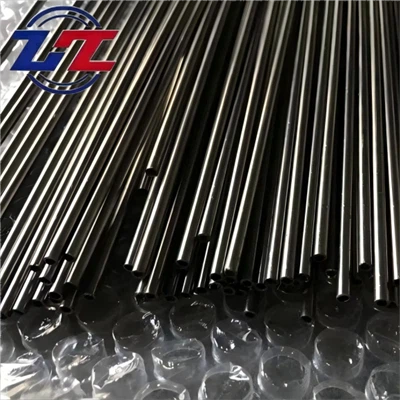
Shaanxi Zhongheng Weichuang Metal Materials Co., Ltd. specializes in the export of metal materials. The company mainly engages in the production of conventional processed profiles such as plates, strips, foils, rods, wires, and tubes made of tantalum, niobium, hafnium, tantalum tungsten alloy, niobium hafnium alloy c103. Niobium tube is a type of pipe made of niobium or niobium alloy, which has a series of unique physical and chemical properties, and is therefore widely used in various fields such as petrochemicals, aerospace, nuclear industry, and electronics industry.




Why Choose Us?
Professional Team
The company has many years of experience in technology and a high-quality work team, which can provide customers with timely and comprehensive service.
Quality Assurance
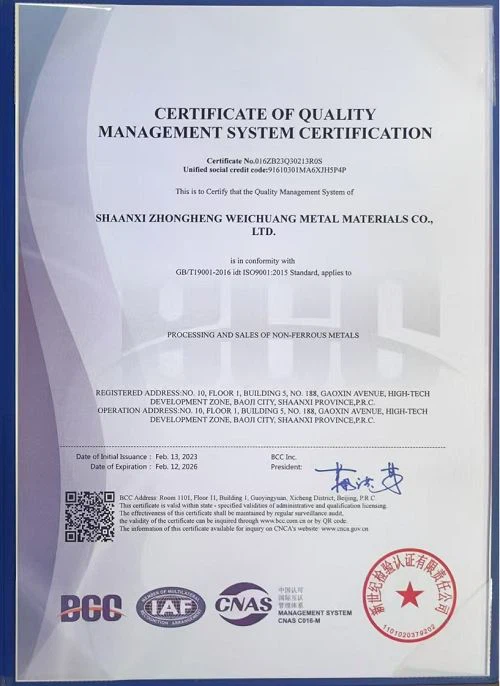
We maintain strict control over every stage, from raw material smelting to finished product export, to ensure the selection of high-quality metal materials and to meet the highest standards at every step.
Production Market
Our non-ferrous metals, such as tantalum, niobium, and titanium, are primarily exported to North America, Europe, and Asia.
Wide Range of Applications
Our products are widely used in a variety of fields, including electronics, metallurgy, chemicals, aerospace, biomedical engineering, and superconductivity, etc.
Parameters of Niobium Tube
|
Product name |
Niobium Tube |
|
Outer Diameter |
5--300 mm |
|
Thickness |
0.5-20 mm |
|
Length |
> 10 mm |
|
Tolerance |
±1% |
|
Application |
Construcion/Building/Industry |
|
Type |
Welded / seamless tube |
Characteristics of Niobium Tube
High-Temperature Resistance:
Niobium has a high melting point of 2,468°C (4,474°F), which makes niobium tubes suitable for high-temperature applications.
Corrosion Resistance:
Niobium is highly resistant to corrosion, especially in acidic environments, making it ideal for use in chemical and nuclear applications.
Ductility and Malleability:
Niobium tubes are flexible and can be easily processed or shaped without losing their properties.

Customization Options
Diameter: Customizable
1
>>
Thickness: Customizable
2
>>
Length: Customizable
3
>>
MOQ: Customized
4
Physical Properties of Niobium Tube
|
Atomic Number |
41 |
|
Atomic Weight |
92.91 |
|
Density |
8.57 gm/cc (0.31 lbs/in2) |
|
Melting Point |
2468 °C |
|
Coefficient of Expansion (20°C – 100°V) |
7.1 x 10⁻⁶/°C |
|
Specific Heat (27°C) |
0.065 cal/gm/°C |
|
Thermal Conductivity |
0.125 cal/sec-cm-°C |
|
Electrical Resistivity (0°C - 100°C) |
14.5 microhm-cm |
|
Crystal Structure |
Bcc |
Usage of Niobium Tube
Aerospace: Niobium's high melting point and corrosion resistance make it suitable for high-temperature applications such as jet engine components, rocket nozzles, and turbine blades.
Medical Devices: Due to its biocompatibility, niobium is used to manufacture medical implants, including pacemaker casings, bone screws, and artificial joints.
Chemical Equipment: Niobium's corrosion resistance makes it ideal for chemical processing equipment and piping systems, particularly in environments that handle strong acids, alkalis, and other corrosive chemicals.
Nuclear Industry: Niobium's low thermal neutron capture cross-section and high heat resistance make it useful as a structural material and fuel cladding in nuclear reactors.
Superconducting Technology: Niobium exhibits superconducting properties at low temperatures, making it essential for superconducting magnets, superconducting cables, and critical components in particle accelerators.
Electronics Industry: Niobium is used in the manufacture of capacitors, electrodes, and other electronic components due to its excellent conductivity and stability.
High-Temperature Furnaces: Niobium tubes and pipes are used in heating elements and protective sheaths in high-temperature furnaces, as they maintain stable physical and chemical properties under extreme heat.

Pure Niobium is the material used to make Superconducting Radio Frequency (SRF) cavities. These cavities need to be free from surface defects like pits, bumps and protrusions to achieve the best performance. Electropolishing is commonly used as a final process to give a good surface finish to the niobium surface. The standard electrolyte used for electropolishing niobium is a 1:9 ratio of HF (48%) and H2SO4 (96%) respectively.
The mechanism of electropolishing is not fully understood and also the best electropolishing parameters need to be determined. Acid concentration, stirring, temperature and amount of material removed are the parameters expected to affect the surface finish. The electro-dissolution occurring needs to be under mass transport control for the phenomenon of electropolishing to occur. This is characterized by the presence of a current density plateau in the niobium polarization curves.
Certificate


Shipping & Payment
|
Shipping: |
By logistics; by automobile; by train; by shipping; by air. |
|
Payment: |
L/C; T/T; Paypal; West Union; MoneyGram etc. |
Packaging of Niobium Tube
The Niobium Tube is securely packed in wooden crates or cartons, reinforced with cushioning materials to prevent movement during transit.
This packaging approach ensures that the products remain intact and protected throughout the shipping process.

FAQ
We're professional niobium tube manufacturers and suppliers in China, specialized in providing high quality customized service. We warmly welcome you to buy niobium tube for sale here and get pricelist from our factory. For price consultation, contact us.
niobium alloy flake, niobium mineral briquettes, niobium oxide residue