

Your Leading Hafnium Tube Supplier
Shaanxi Zhongheng Weichuang Metal Materials Co., Ltd. specializes in the export of metal materials. The company mainly engages in the production of conventional processed profiles such as plates, strips, foils, rods, wires, and tubes made of tantalum, niobium, hafnium, tantalum tungsten alloy, niobium hafnium alloy c103. Hafnium tube is a glossy silver gray transition round tube. Due to the strong thermal neutron capture ability of hafnium, hafnium tubes are used as neutron absorbers for reactor control rods. By inserting or lifting hafnium control rods into fuel assemblies, the power of the reactor can be adjusted to ensure controllable chain reactions.


Why Choose Us?
Professional Team
The company has many years of experience in technology and a high-quality work team, which can provide customers with timely and comprehensive service.
Quality Assurance
We maintain strict control over every stage, from raw material smelting to finished product export, to ensure the selection of high-quality metal materials and to meet the highest standards at every step.
Production Market
Our non-ferrous metals, such as tantalum, niobium, and titanium, are primarily exported to North America, Europe, and Asia.
Wide Range of Applications
Our products are widely used in a variety of fields, including electronics, metallurgy, chemicals, aerospace, biomedical engineering, and superconductivity, etc.
Parameters of Hafnium Tube
|
Material: |
Hf+Zr≥99.95%, Zr≤0.2%/0.5%/1.0% |
|
Purity: |
99%-99.95% |
|
Dimension: |
Out Diameter: 0.05-200 mm |
|
Wall Thickness: 0.05-80 mm |
|
|
Length: 30-6000 mm |
|
|
Or customized |
|
|
Temper: |
Annealed and Unannealed |
Application Scope ofHafnium Tube
Aerospace Sector:
Utilized in high-performance elements demanding superior heat resistance and strength, including engine components and thermal shields.
01
Nuclear Energy:
Acts as a neutron-capturing substance in nuclear reactors, assisting in regulating the reaction speed and guaranteeing safe functioning.
02
Electronics:
Used in manufacturing sophisticated electronic parts, where its elevated melting point and corrosion resistance are vital for effectiveness.
03
High-Temperature Alloys:
Incorporated into alloys employed in extreme thermal settings, like turbine engines and advanced heat exchangers.
04
Medical Devices:
Employed in specialized healthcare equipment, especially in settings where protection against radiation and resistance to corrosion are essential.
05
Chemical Properties of Hafnium Tube
|
Properties |
Metric |
|
Density |
13.31 g/cm3 |
|
Melting Point |
2220°C |
|
Boiling Point |
5200°C |
|
Thermal Conductivity |
22 W/(m·K) |
|
Thermal Expansion Coefficient |
5.9 µm/(m·K) |
|
Tensile Strength |
485 MPa |
|
Yield Strength |
125 MPa |
Melting and Casting:
Hafnium or hafnium alloys are usually melted into ingots by vacuum self-consuming arc melting.
Forging and Extrusion:
The ingot is heated and forged to make a preliminary tube blank, which is then further processed into the desired size and shape through the extrusion process.
Cold Rolling and Drawing:
Cold rolling and drawing are key steps in producing hafnium tubes. Cold rolling improves the mechanical properties and surface quality of the tubes, while drawing is used to further reduce the diameter and wall thickness of the tubes.
Heat Treatment:
Annealing is usually carried out in a high vacuum environment to avoid oxidation and contamination and to remove stresses generated during processing.
Finishing & Inspection:
Steps such as cutting, polishing, cleaning, and strict quality inspection ensure that the product meets specifications.
Handling Precautions of Hafnium Tube
When used for nuclear reactor control rod casing, it is necessary to ensure that the neutron absorption cross-section of the hafnium tube meets the standard (>100 target En), and the installation position accurately matches the core design requirements.
The pipe interface must be double sealed to prevent leakage of fission products; Regularly check the thickness of the pipe wall and replace it immediately if the loss exceeds 10%.
Halogen compounds such as uranium hexafluoride (UF ₆) can corrode hafnium pipes, and the transportation of such media requires lining with corrosion-resistant coatings or using zirconium alloy pipes instead.
When used for transporting semiconductor sputtering targets, the oxygen content in the pipeline system should be<1ppm to prevent hafnium oxidation and the formation of brittle HfO ₂ layer.
Every month, XRD is used to detect the thickness of the oxide layer on the pipe wall. If the HfO ₂ phase transition exceeds 5 μ m, polishing treatment is required to avoid affecting thermal conductivity.
Every quarter, penetrant testing is used to investigate micro cracks, with a particular focus on welding areas and bent pipe sections.
Hardness of Hafnium Tube
|
Mohs hardness |
5.5 |
|
Vickers hardness |
1520–2060 MPa |
|
Brinell hardness |
1450–2100 MPa |
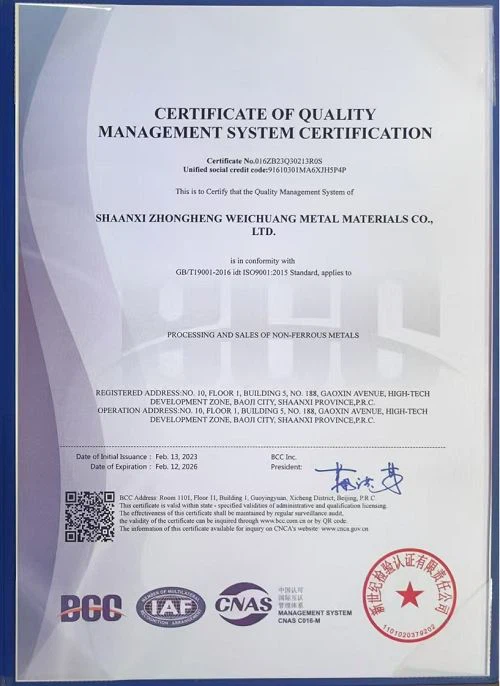
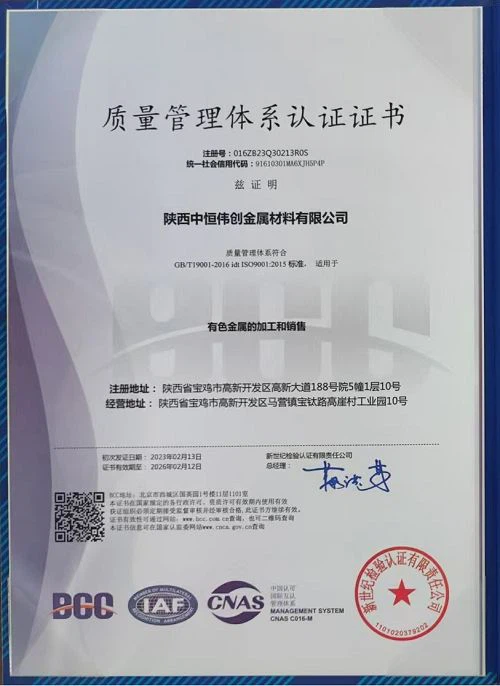
Certificate


Packaging of Hafnium Tube
The Hafnium Tube is securely packed in wooden crates or cartons, reinforced with cushioning materials to prevent movement during transit. This packaging approach ensures that the products remain intact and protected throughout the shipping process.

fAQ
We're professional hafnium tube manufacturers and suppliers in China, specialized in providing high quality customized service. We warmly welcome you to buy hafnium tube for sale here and get pricelist from our factory. For price consultation, contact us.