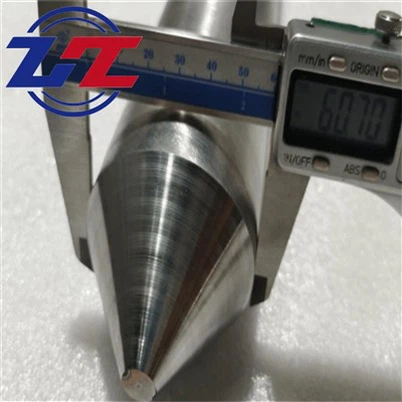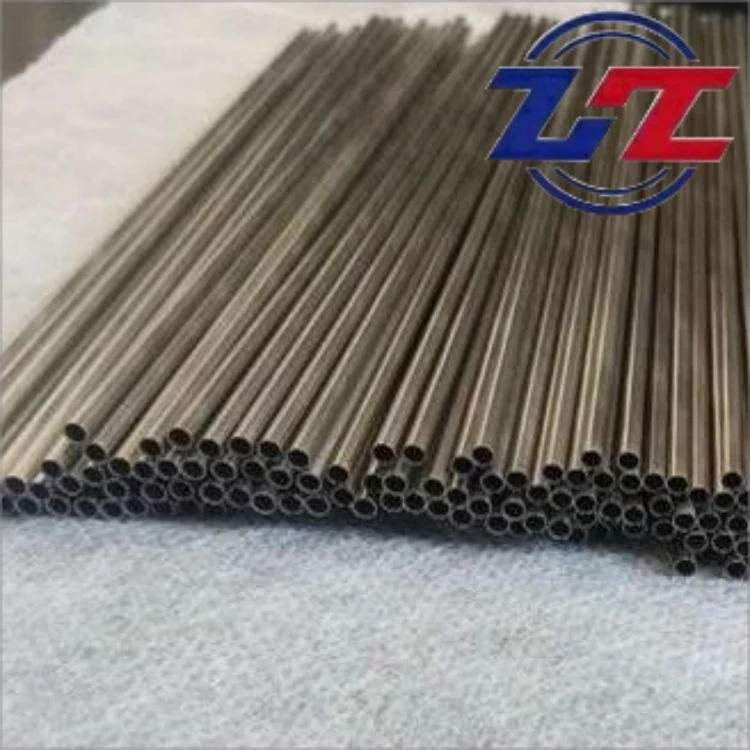
Hafnium Tungsten Alloy Tube
Hafnium tungsten alloy tube is not made of hafnium as the matrix, but of tungsten (W) as the matrix, and is made of an alloy formed by adding a small amount of hafnium (Hf) and sometimes carbon (C). Its most notable characteristics are extremely excellent high-temperature strength and creep resistance, but this often comes at the cost of sacrificing room temperature toughness (brittleness) and processability.
Description
Although pure tungsten has a very high melting point (3422 ° C), it has serious problems of "low-temperature brittleness" and recrystallization brittleness, and its strength will sharply decrease at high temperatures. Adding hafnium (usually in the form of HfC, hafnium carbide) can greatly improve these properties:
- Dispersion strengthening and second phase strengthening: Hafnium forms extremely small, hard, and thermally stable hafnium carbide (HfC) particles with carbon. These particles are uniformly dispersed in the tungsten matrix, effectively pinning grain boundaries and preventing grain growth and movement at high temperatures, thereby significantly improving the high-temperature strength and creep resistance of the alloy (the ability to resist deformation at high temperatures).
- Inhibition of recrystallization: HfC particles can significantly increase the recrystallization temperature of tungsten, allowing the alloy to maintain its unrecrystallized fibrous structure at higher temperatures, thereby maintaining its high-temperature mechanical properties.
- Maintain high melting point: The overall melting point of the alloy is still very high, close to pure tungsten
Core manufacturing process of hafnium tungsten alloy tube


1. Powder Preparation and Mixing
- Raw materials: high-purity and ultrafine tungsten powder (W), hafnium powder (Hf) or more commonly hafnium carbide powder (HfC), as well as an appropriate amount of carbon powder (C) are used.
- Mixing: Mix various powders according to a precisely designed chemical composition ratio (e.g. W: 4% Hf: 1% C). The mixing process must be carried out under high-purity inert gas protection or vacuum environment to prevent oxidation and contamination. Using high-energy ball milling and other methods to ensure uniform mixing of the powder.
2. Forming
As it is a powder, it needs to be pressed into a tubular "green body" first. Common methods include:- Cold Isostatic Pressing (CIP): The mixed powder is loaded into an elastic mold (such as a rubber or plastic mold), placed in a high-pressure cylinder, and subjected to isotropic ultra-high pressure (usually 200-400 MPa) through a liquid medium to compress the powder into a dense tubular body. This method has uniform density and is the preferred method.
- Die Pressing: For simple shapes, unidirectional or bidirectional pressure can also be applied in a rigid mold, but the density uniformity is not as good as CIP.
3. Sintering
This is the most critical heat treatment process, aimed at firmly bonding powder particles together through atomic diffusion to obtain a nearly dense alloy.- Condition: Conduct long-term sintering under high temperature (usually up to 2000-2400 ° C), hydrogen protection, or vacuum environment.
- Process: At high temperatures, tungsten, hafnium, and carbon atoms diffuse to form new phases (especially the formation of dispersed hafnium carbide HfC particles), while the internal pores of the material decrease, shrink, and densify, thereby obtaining the final alloy structure and properties.
4. Machining
The sintered hafnium tungsten alloy tube (referred to as the "sintered billet") is very hard and brittle, like ceramics, and cannot undergo conventional cutting processes such as turning, milling, and drilling. Special processing methods must be used:- Grinding: Using diamond grinding wheels for outer circle, inner hole, and centerless grinding to achieve precise dimensions and smoothness. This is the most commonly used precision machining method.
- Electrical Discharge Machining (EDM): The use of high temperatures generated by continuous pulse discharge to corrode metal materials. Suitable for processing complex shapes or deep holes. including:
Wire EDM: Used for cutting shapes and long pipes.
EDM Drilling: Used for machining small holes.- Ultrasonic Machining: Sometimes also used for auxiliary machining.
5. Post Processing
- Cleaning: Remove coolant and impurities during the processing.
- testing:
Non destructive testing: Ultrasonic testing (UT) or X-ray testing for internal defects.
Dimensional inspection: Ensure that the tolerance meets the requirements.
Metallographic examination: Check whether the microstructure is uniform and whether the distribution of HfC dispersed phase is good.
Summary of process difficulties and characteristicsShaanxi Zhongheng Weichuang Metal Materials Co., Ltd., as a leading hafnium material manufacturer and global exporter in China, has always been committed to providing customers with high-quality and high-purity hafnium products. We insist on integrated operation from production to sales, without any intermediate links, to ensure that you can obtain reliable products directly supplied from the source at the most competitive price.
The company strictly controls every production process, and all hafnium materials meet international standards with solid and guaranteed quality. We have a professional customer service team that is always online to respond to your needs, providing worry free services throughout the entire process from technical consultation to after-sales support, ensuring smooth cooperation and peace of mind in procurement.
If you have any needs, please feel free to inquire:
Email: zhwcjs2022@163.com
Shaanxi Zhongheng Weichuang Metal Materials Co., Ltd. is willing to create value with global customers through excellent products and sincere services, and work together for win-win results!
Hot Tags: hafnium tungsten alloy tube, China hafnium tungsten alloy tube manufacturers, suppliers, factory
Send Inquiry
You Might Also Like