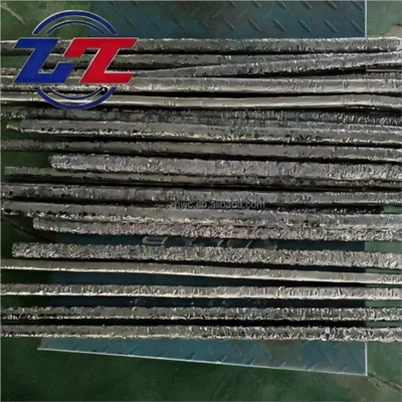
Hafnium Rods For Aerospace Applications
Hafnium rod for aerospace is a high-performance material based on hafnium metal, designed specifically for extreme environments in aerospace. Hafnium has become a key material in fields such as aviation engines, aerospace propulsion systems, and space nuclear power due to its high melting point, excellent high-temperature strength, oxidation resistance, and neutron absorption ability.
Description
Hafnium rods must have an ultra-high melting point (2233 ° C) and maintain structural strength in an environment of 1600-2000 ° C. The oxidation resistance temperature can be increased to above 2000 ° C through surface hafnium carbide (HfC) or hafnium disilicide (HfSi ₂) coatings. This characteristic is the basis for its application in rocket engine nozzle throat liners and hypersonic aircraft leading edges, and it needs to withstand 3000 ° C gas erosion or aerodynamic heating with Mach number greater than 5 without ablation failure.
This material needs to have high strength (tensile strength ≥ 200 MPa at 1200 ° C), high creep resistance, and low thermal expansion coefficient at high temperatures, and be able to withstand severe temperature changes (such as engine ignition/shutdown cycles) without cracking. This feature is crucial for the coating substrate of aircraft engine turbine blades and combustion chamber supports to prevent structural delamination caused by thermal fatigue.
It also needs to resist the corrosion of aviation fuel combustion products (such as sulfides), hydrazine propellants, and high-temperature and high-pressure oxidation atmospheres, with an annual corrosion rate of less than 0.01 mm. This condition ensures its long-term stable operation in rocket engine fuel valve cores and re-entry thermal protection systems, avoiding failures caused by corrosion.
Hafnium rods used for nuclear thermal propulsion or space reactors need to leverage their high neutron absorption cross-section (104 bar) advantage. They can serve as cladding materials for uranium fuel elements to prevent nuclear leakage and regulate reaction rates through neutron absorption, providing a dual guarantee for control and safety protection in deep space exploration nuclear power systems.
Optimize the design while meeting performance requirements, and reduce weight through hollow structures, composite materials, and other methods. At the same time, it is necessary to have good weldability (compatible with electron beam welding), coating adhesion, and machinability to meet the manufacturing and maintenance needs of complex aerospace components.
Core process flow
The manufacturing process integrates high-purity metallurgy, precision thermal processing, and surface engineering technologies


1, Preparation of high-purity hafnium raw materials
- Separation and Purification of Hafnium Zirconium
Nuclear grade hafnium is extracted from zirconium hafnium co occurring ore using extraction and separation techniques (such as MIBK thiocyanate system), and electron beam melting (EBM) is used to further remove impurities such as oxygen and nitrogen, obtaining a purity of ≥ 99.8% in the ingot, ensuring the high-temperature performance and corrosion resistance of the substrate.
- Alloying design
Adding elements such as carbon (C) and silicon (Si) to form hafnium alloys (such as Hf-C and Hf-Si) enhances high-temperature strength and oxidation resistance, and ensures compositional uniformity through vacuum consumable arc melting (VAR).
2, Thermomechanical processing and forming
- Hot forging billet
Multi directional forging is carried out on the γ - phase region (>1300 ° C) to break down the as cast structure, refine the grain size, and initially form a rod billet (diameter of φ 100-200 mm).
- Hot extrusion and rolling
Hot extrusion or hot rolling is carried out under a protective atmosphere (argon gas) to reduce the diameter of the bar to the target size (such as φ 50-100 mm), and the temperature is strictly controlled during the process to prevent oxidation.
- cold finish
By cold drawing or cold rolling to improve dimensional accuracy (tolerance ± 0.1 mm), and conducting intermediate annealing (800-900 ° C/vacuum) to eliminate processing stress, precision hafnium rods with a diameter of 10-150 mm are finally obtained.
3, Surface high-temperature coating treatment
- Preparation of Hafnium Carbide (HfC) Coating
Using chemical vapor deposition (CVD) to generate HfC coating (thickness 50-200 μ m) on the surface of hafnium rod, the anti-oxidation temperature is raised to over 2000 ° C, suitable for rocket engine nozzle throat lining.
- Preparation of Hafnium Disilicide (HfSi ₂) Coating
HfSi ₂ coating (thickness 100-300 μ m) is formed by slurry sintering method, which is resistant to high temperature oxidation at 1600 ° C and used on the leading edge of hypersonic aircraft.
- laser surface alloying
Laser cladding is applied to local areas (such as engine blade tenons) to generate a wear-resistant and corrosion-resistant strengthening layer.
4, Performance testing and aerospace certification
- High temperature performance testing
1600 ° C antioxidant test (oxidation weight gain<1 mg/cm ² · h);
1200 ° C high temperature tensile test (strength ≥ 200 MPa) and creep test (deformation<1% after 100 hours).
- Non-destructive testing
Ultrasonic flaw detection for internal defects;
X-ray inspection of coating bonding strength and porosity.
- Aerospace standard certification
Compliant with AMS 7898 (Specification for Hafnium Materials in Aerospace) and NASA-SPEC-5000 series standards, ensuring that the material is suitable for the space environment.
Shaanxi Zhongheng Weichuang Metal Materials Co., Ltd., as a leading hafnium material manufacturer and global exporter in China, has always been committed to providing customers with high-quality and high-purity hafnium products. We insist on integrated operation from production to sales, without any intermediate links, to ensure that you can obtain reliable products directly supplied from the source at the most competitive price.
The company strictly controls every production process, and all hafnium materials meet international standards with solid and guaranteed quality. We have a professional customer service team that is always online to respond to your needs, providing worry free services throughout the entire process from technical consultation to after-sales support, ensuring smooth cooperation and peace of mind in procurement.
If you have any needs, please feel free to inquire:
Email: zhwcjs2022@163.com
Shaanxi Zhongheng Weichuang Metal Materials Co., Ltd. is willing to create value with global customers through excellent products and sincere services, and work together for win-win results!
Hot Tags: hafnium rods for aerospace applications, China hafnium rods for aerospace applications manufacturers, suppliers, factory, hafnium 174, hafnium 177, hafnium fines, hafnium ore, hafnium tube, pure hafnium
Send Inquiry
You Might Also Like